

Occupational Therapy
Creating independence for all ages by improving skills in meaningful everyday activities.
Difficulty with daily activities is discouraging at any age, and can take a toll on families. Treatment plans from our Occupational Therapy Team foster independence by helping clients improve and own occupations such as dressing, feeding, play, school, and sleep. Our occupational therapists are licensed by the state of California and certified by the National Board of Occupational Therapists, and value lifelong professional development and and learning so that treatment is always based on current research and best practices.
Questions about a diagnosis?
Reach out and we'll help you understand what it means.




Diagnosis & Signs Section
“How do I know if my child really needs therapy?” (speech delay vs. typical variation, behavior thresholds, academic struggles)
“What are red flags for speech/language/behavioral/learning issues?” (not just “we provide services”)
“What does an initial evaluation look like? What happens, who’s involved, how long does it take?”

The Occupational Therapy Journey
Evaluationation
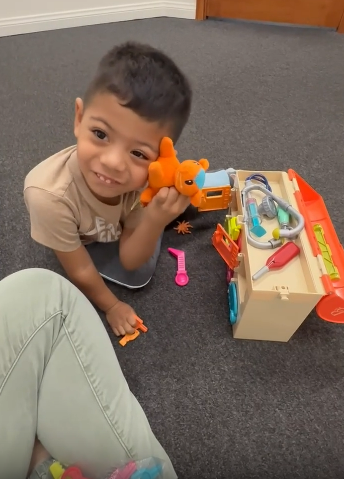
Michael struggled with communication, attention, and following directions, making it difficult to engage consistently during everyday activities.
From Evaluation to Progress
Process
Lorem ipsum dolor sit amet, consectetur adipiscing elit, sed do eiusmod tempor incididunt ut labore et dolore magna aliqua. Ut enim ad minim veniam, quis nostrud exercitation
Progress
Lorem ipsum dolor sit amet, consectetur adipiscing elit, sed do eiusmod tempor incididunt ut labore et dolore magna aliqua. Ut enim ad minim veniam, quis nostrud exercitation

Occupational Therapy Services
Our Occupational Therapists are equipped to provide care in a wide range of specialized areas. Many have earned certification in unique methodologies, including but not limited to:
Early Intervention • Sensory Integration • NDT • Handwriting without Tears • Visceral Manipulation • Infant Stimulation • The Alert Program • Zones of Regulation • DIR/FloorTime • Feeding • Schools • Ergonomic Design/Home Modifications
Questions about a diagnosis?
Reach out and we'll help you understand what it means.
Get Started Section

Meet Our Occupational Therapy Leadership Team
-
![SLEA Therapies Occupational Therapy and Speech and Language Therapy Director.]()
Dr. Baily Zubel
Senior Director of Speech and OT Programs
-
![SLEA Therapies Occupational Therapy Lead Culver City, Torrance.]()
Maddie
Lead Occupational Therapist
-
![SLEA Therapies Occupational Therapy Lead Encino.]()
Melinda
Lead Occupational Therapist


-
Pediatric occupational therapy helps children develop the skills they need for daily life - things like dressing, writing, using utensils, playing, and managing sensory input from the environment. An occupational therapist evaluates where a child is struggling and creates a personalized plan to build those foundational skills.
-
Your child may benefit from OT if they struggle with fine motor tasks (holding a pencil, using utensils, using scissors, fastening buttons, zippers), have sensory sensitivities (overreacting or under reacting to touch, sound, or movement), show poor attention or coordination, have difficulty with self-care routines, or avoid certain textures and activities. An evaluation will clarify whether OT is the right fit.
-
Signs include extreme sensitivity to sounds, lights, textures, or clothing tags; seeking intense sensory input such as crashing or spinning; difficulty transitioning between activities; frequent meltdowns in busy environments; poor coordination or body awareness; and distress during routine activities like hair washing or nail trimming. An OT can evaluate whether sensory processing is contributing to these behaviors.
-
Occupational therapy focuses on a child's ability to participate in daily life by looking for underlying challenges. Those various underlying skills may be fine motor delays, sensory processing challenges, low muscle tone/generalized weakness, and/or visual motor and visual perceptual difficulties. Physical therapy focuses on gross motor delays, strength, mobility or rehabilitation following injury or medical condition. The two disciplines can go hand in hand depending on the needs of the child.
-
OT can begin in infancy - we work on positioning, rolling crawling, and learning to interact with the world. There is no minimum age. Earlier intervention generally leads to faster progress, so if you have concerns about your baby, toddler, or school-age child, do not wait - request an evaluation and we will determine the best path forward.
-
Sessions are typically play-based and child-led, using activities that feel fun while targeting specific therapeutic goals. You may see your child climbing, swinging, doing puzzles, practicing with scissors, or working through sensory activities. Every activity has a clear clinical purpose guided by the therapist.
-
Yes, but typically handwriting concerns alone are seen by a school-based occupational therapist. Insurance companies do not qualify handwriting as a medical necessity. If there are other challenges corresponding with handwriting concerns, clinic-based OTs are able to target the underlying challenges. OT addresses the underlying causes - hand-eye coordination, visual perceptual skills, pencil control, and letter formation - rather than just repeating handwriting practice in isolation.
-
OT is a cornerstone of autism support. Therapists work on sensory regulation, daily living skills, social participation, fine motor development, and emotional self-regulation. OT is often recommended alongside speech therapy and ABA therapy as a team approach to support autistic children.
-
Duration depends on your child's goals, the areas of concern, and how they respond to intervention. Some children meet their goals in a few months; others benefit from longer-term support. Your therapist will set measurable goals and review progress at regular intervals.
-
Many insurance plans cover pediatric OT when it is medically necessary. Coverage details - including visit limits, copays, and whether a referral is needed - vary by plan. We recommend contacting your insurance provider directly, and our team is happy to help you navigate the process.
Frequently Asked Questions